Table of contents
Over the past few years, many holiday parks have invested heavily in the digital guest journey. There's an app or an online portal for booked guests, with the activity schedule, the park map, pool hours and everything about check-in. That's valuable work, and your guests use it.
Still, something often nags. The app is on thousands of phones, but activities aren't filling up, the restaurant is as quiet on Tuesday night as it always was and the front desk keeps getting the same questions. The app informs. It doesn't activate.
Key takeaways
- An information app answers the question a guest already has. An activation layer spots the opportunity the guest hasn't seen yet.
- The difference isn't the screen. It's what sits underneath: knowing who's coming, what's happening right now and when a suggestion is welcome.
- Building a new app is rarely the answer. The app you already have can stay the front end.
- Four questions tell you whether your app informs or activates today.
Informing and activating are two different jobs
An information app is a reference guide. It's as good as the content in it, and as active as the guest who opens it. If you look, you'll find. If you don't, you won't notice a thing.
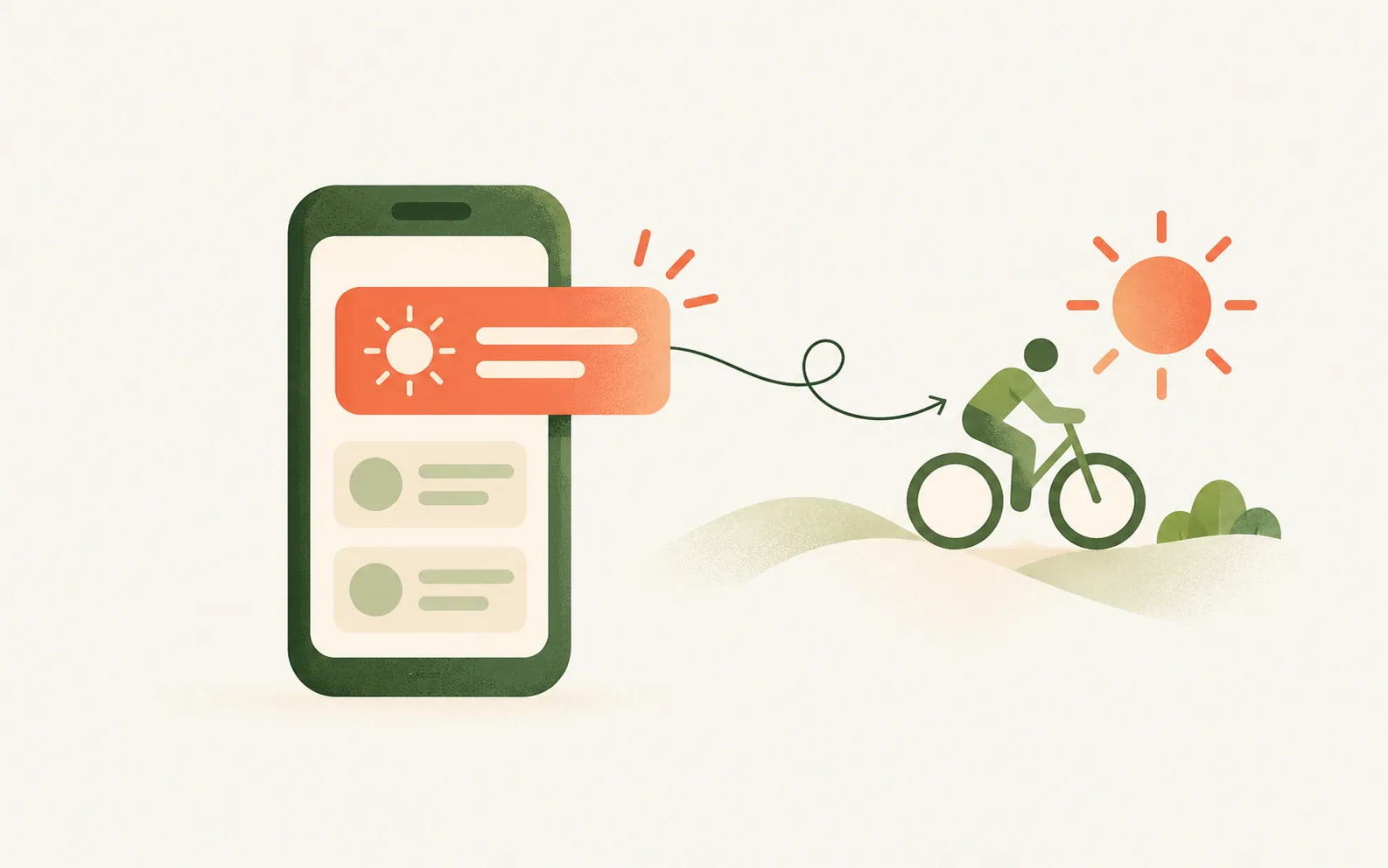
Activation starts from the other end. Not from the guest's question, but from the guest's moment. A family with two young kids facing rain tomorrow. A couple who still hasn't planned anything on day two. A group that went mountain biking yesterday and has a free afternoon today. In those situations, there's no question. There is an opportunity.
In The booking is just the beginning, Raymond described how most of a guest's value is unlocked after the booking. This post goes one layer deeper: what do you need to actually capture that value when you already have an app?
What an information app doesn't know
Most guest apps are built around content: pages, lists and a map. That's a logical choice, because content is what a park manages. But to suggest something relevant to a guest at the right moment, you need three things that usually don't live in a content system.
Who's coming
What's in the reservation? Who's in the travel party? Is this the first visit or the fifth? What has this guest booked or looked at before? That data often already exists, scattered across your property management system (PMS), your CRM and your analytics. An information app rarely sees it.
What's happening right now
Tomorrow's weather, the open spots on the 2 p.m. forest walk, how busy the pool is, a market in the next village over. Relevance is time-sensitive. A tip that was right yesterday can be wrong today.
Whether a suggestion is welcome
This is the hardest of the three, and the one most often skipped. Not every opportunity justifies a message. An app that sends three push notifications a day teaches guests to ignore them. Activation also means deciding to send nothing when the signals aren't strong enough.
The problem isn't the app. It's the layer underneath.
This is where the digitalization conversation often goes wrong. If the app doesn't activate, the logical conclusion seems to be that you need a better app. That's usually an expensive detour.
The screen isn't the problem. Your guests already have the app, they know how it works and your team has built up the content in it. What's missing is a layer that pulls together the data from your systems, understands what's going on for each guest and decides when a suggestion adds value. You can put that layer underneath the app you already have.
At GleeGuide, that layer is AI Brain Sentio. Sentio connects your reservation data, your content, your activity schedule, the weather and the area around your park. On top of it, hospitality-trained AI agents each handle their own task: one finds the right activity, another spots an upgrade opportunity, a third recognizes that something in the accommodation is broken. With the In-App Assistant, all of that lands inside the app you already have, without guests having to download anything new.
So no rip-and-replace. Your app stays the front end. What changes is what happens behind it.
Four questions to test your own app
Want to know whether your app informs or activates today? Walk through these four questions, ideally with someone from the front desk and someone from marketing.
- Does a family with young kids see something different on arrival day than a couple on their third visit? If not, your app doesn't know who's coming.
- Does what the app suggests change when it's going to rain tomorrow? If not, your app doesn't know what's happening right now.
- Can a guest reserve or book straight from a suggestion, without clicking through to another website or picking up the phone? If not, activation stops at inspiration.
- Does your organization learn from what guests do in the app, and use it for their next stay? If not, every guest starts from zero.
A few noes? That makes sense, because most apps were built to inform. But it shows exactly where your next step is.
From informing to activating, without starting over
The step from informing to activating is smaller than it looks, precisely because the foundation is already there. You have content, you have guests using the app and you have data in your systems. What you add is the ability to connect those three at the right moment.
Start small. Pick one moment in the guest journey where you know value is being left on the table, like the first afternoon after arrival or a rainy day. Turn on activation there, measure what it does and only expand once it works. Curious how that kind of conversation with guests works on WhatsApp, and what to expect from it? Read our post on WhatsApp and AI assistants.
Your app tells guests what there is to do. The next step is an app that knows what this guest wants to do today.
Tomorrow, open your own app as if you were a guest. What does it suggest, and would you say yes to it today?
Vincent Baardman Vincent leads digital marketing and go-to-market for GleeGuide. He writes about how holiday parks and hotels turn guest intent into experiences, conversion and margin, and how AI changes the way guests discover, book and enjoy their stay.